A comprehensive analysis of wearable health technology, comparing smartwatches, fitness trackers, and smart rings to help you choose the perfect health monitoring device for your needs.
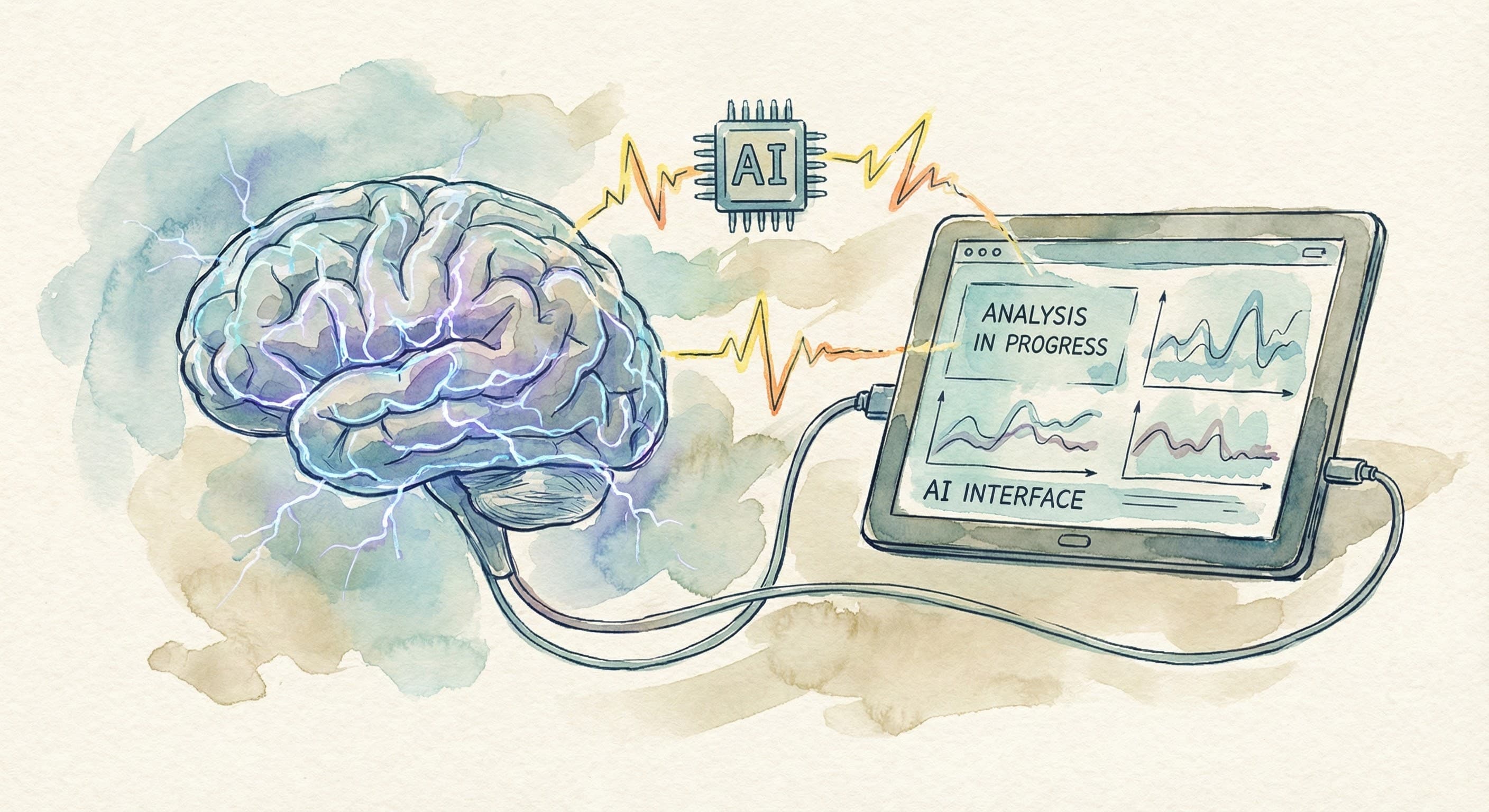
The world of brain monitoring has fundamentally shifted. What was once confined to clinical laboratories and research hospitals is now strapped to the heads of productivity-obsessed professionals, biohackers, and people simply trying to sleep better. The global cognitive enhancement wearable market is projected to grow at 17% annually through 2034, driven by two converging forces: hardware that's finally small enough to wear all day, and AI that's finally smart enough to make sense of the chaos of neural signals.1
The Hardware Breakthrough: From Wet Electrodes to All-Day Comfort
Traditional EEG systems required conductive gels and wet electrodes—fine for a hospital, impossible for your morning commute. The 2024-2025 period has changed this equation with advanced dry-electrode materials including conductive polymers and silver-plated fabric sensors that approximate clinical signal quality without the mess.23
But the real story is multimodal sensing. Today's devices don't just measure one thing—they combine EEG (electrical brain activity), fNIRS (blood oxygenation in the prefrontal cortex), PPG (heart rate variability), and even EMG (muscle activity). This creates what researchers are calling "biometric psychography"—a holistic picture of cognitive state that single-sensor devices could never achieve.45
The Muse S Athena and Sens.ai headsets exemplify this approach. EEG tells you what your brain is doing (alpha waves for relaxation, gamma for intense focus), while fNIRS tells you how hard it's working to maintain that state.6 It's the difference between knowing you're focused and knowing that focus is costing you.
The AI Engine: From Raw Noise to Actionable Insight
Raw neural data is a nightmare—high-dimensional, constantly shifting, and buried under artifacts from eye blinks, jaw clenches, and the electrical hum of the world around you. Traditional analysis required computational power and manual oversight that made real-time processing impossible on a wearable device.
Enter deep learning. Convolutional neural networks (CNNs), particularly architectures like EEGNet, have become the gold standard for on-device processing.7 These models distinguish genuine neural activity from noise automatically, running on the low-power chips inside headphones and headbands. Research shows EEGNet achieves 85-89% accuracy across subjects while remaining computationally light enough for edge computing.8
The late 2025 frontier is even more ambitious: researchers have demonstrated that feeding EEG features into large language models can improve mind-to-text generation by 10% while drastically reducing the training data needed for each user.9 The emerging architecture is hybrid—lightweight CNNs for immediate processing on the device, cloud-based transformers for complex semantic interpretation.
The Consumer Market: Productivity, Focus, and Burnout Prevention
The consumer sector has moved decisively toward "prosumer" devices targeting high-performance professionals. The trend is toward all-day wearability in inconspicuous form factors—premium headphones, not bulky headbands.
The Neurosity Crown uses an 8-channel EEG array to measure gamma waves associated with flow states. Its adaptive-audio neurofeedback helps users enter focused states, with the company claiming 80% of users report positive impact within two minutes.10
The Neurable MW75 Neuro takes a different approach, focusing on burnout prevention rather than focus enhancement. Launched in a more accessible $499 "LT" version in 2025, these headphones detect mental fatigue before the wearer feels it, suggesting brain breaks to optimize long-term productivity. Studies indicate that following these recommendations can increase daily productivity by 20%.1112
This represents a paradigm shift: the first mass-market wearable that translates neural load into proactive schedule management.
Clinical Applications: When Consumer Meets Medical
A persistent tension exists between consumer device convenience and medical-grade reliability. Comprehensive studies comparing systems reveal the trade-offs clearly. Medical-grade devices like the B-Alert X24 use 20-channel wet electrode arrays with highly consistent test-retest reliability. Consumer devices like the Muse S use 4 EEG channels plus fNIRS with dry electrodes—more variable, but sufficient for sleep and meditation research when multi-night data is collected.1314
The clinical community generally recommends medical-grade systems for monitoring disease progression and drug effects, where precision matters most. But consumer devices like the Dreem 3 (now Waveband) have demonstrated sleep staging agreement with clinical polysomnography that's acceptable for at-home research.15
The Life-Saving Edge: Seizure Detection
One application transcends the productivity-wellness divide: automated seizure detection and alerting. This sector saw rapid FDA clearances in 2024-2025, moving from passive logging to proactive emergency response.
The Empatica EpiMonitor combines electrodermal activity, motion, and PPG sensing with 98% accuracy and a 7-day battery life.16 The EpiWatch app turns any Apple Watch into an FDA-cleared seizure detector (prescription required).17
But the most profound innovation comes from KNoW Biological's VoLI monitor, which received FDA Breakthrough Device Designation. This skin patch detects metabolic "pre-seizure" markers in volatile organic compounds released through the skin, providing a 40-minute warning window.18 This allows patients to reach safety or take rescue medication before a seizure begins—something motion-based wristbands that detect seizures only after onset cannot offer.
Smart Glasses: The Emerging Platform
The industry has realized that head-worn devices are optimal for brain monitoring, driving a merger between BCI and smart glasses. AAVAA has developed glasses with fabric sensors that track facial gestures and eye movement, enabling "blink to click" control for wheelchair users and others with mobility impairments.1920
Research platforms like OpenBCI's Galea have evolved into untethered all-in-one headsets combining EEG, EMG, and eye tracking, enabling applications like foveated rendering in VR—optimizing display quality based on real-time cognitive load and gaze location.21
The Privacy Reckoning: Neurorights and the MIND Act
Neural data reveals subconscious thoughts, emotions, and future health risks. This intimacy demands new regulatory frameworks.
In September 2025, the Management of Individuals' Neural Data (MIND) Act was introduced in the US Senate, addressing what lawmakers called a "regulatory vacuum."22 The legislation mandates FTC study of neural data governance, requires federal guidance on permissible neurotechnology uses, and targets the monetization of neural data by third-party brokers.
The urgency is justified. A 2024 Neurorights Foundation audit of thirty consumer neurotech companies found that 96.7% reserved the right to transfer brain data to third parties, and fewer than 20% committed to basic encryption standards.23 Chile and Spain have already adopted "neurorights" establishing mental privacy, personal identity, and free will as fundamental human rights.24
What Comes Next
The trajectory points toward personalized, preventive care. Custom neural processing units tuned for EEG's 1-120 Hz frequency range will enable more sophisticated on-device AI. Smart textiles will embed biosensors directly into everyday clothing. And the integration of AI will enable "digital twins" of the brain—personalized models predicting individual responses to neurostimulation or medication.25
The technology is mature enough to support clinical-grade applications in home environments. Whether society is mature enough to deploy it responsibly—protecting mental privacy while unlocking the brain's potential—remains the defining question of this decade.
References
Footnotes
-
Expert Market Research. "Best 8 Cognitive Enhancement Wearable Tech Companies in 2025." https://www.expertmarketresearch.com/healthcare-articles/top-companies-in-the-cognitive-enhancement-wearable-technology-market ↩
-
PMC. "Comparison of Medical and Consumer Wireless EEG Systems for Use in Clinical Trials." https://pmc.ncbi.nlm.nih.gov/articles/PMC5540902/ ↩
-
Neuphony. "Neuphony EEG Headband | Advanced Neurofeedback for Wellness & Focus." https://www.neuphony.com/product/brain-wearables/neuphony-eeg-headband ↩
-
PMC. "Regulating neural data processing in the age of BCIs: Ethical concerns and legal approaches." https://pmc.ncbi.nlm.nih.gov/articles/PMC11951885/ ↩
-
Sens.ai. "Sens.ai Headset." https://sens.ai/store/headset ↩
-
Muse. "Top 7 brain training devices 2025: Muse, Mendi & more." https://choosemuse.com/blogs/news/top-brain-training-devices-2025 ↩
-
ResearchGate. "An optimized EEGNet processor for low-power and real-time EEG classification in wearable brain-computer interfaces." https://www.researchgate.net/publication/378317884_An_optimized_EEGNet_processor_for_low-power_and_real-time_EEG_classification_in_wearable_brain-computer_interfaces ↩
-
arXiv. "Deep comparisons of Neural Networks from the EEGNet family." https://arxiv.org/html/2302.08797v1 ↩
-
arXiv. "Neurocognitive Modeling for Text Generation: Deep Learning Architecture for EEG Data." https://arxiv.org/html/2509.07202v2 ↩
-
Neurosity via Wefunder. "Neurosity: Mental health minus the medicine." https://wefunder.com/neurosity ↩
-
Neurable. "MW75 Neuro LT." https://www.neurable.com/products/mw75neurolt ↩
-
SoundGuys. "I tried the MW75 Neuro, and it's a brain-tracking game changer." https://www.soundguys.com/mw75-neuro-107922/ ↩
-
ResearchGate. "Comparison of Medical and Consumer Wireless EEG Systems for Use in Clinical Trials." https://www.researchgate.net/publication/318883363_Comparison_of_Medical_and_Consumer_Wireless_EEG_Systems_for_Use_in_Clinical_Trials ↩
-
Journal of Sleep Research. "Re-evaluating two popular EEG-based mobile sleep-monitoring devices for home use." https://lerner.sleepmemory.lab.utsa.edu/wp-content/uploads/2023/02/Journal-of-Sleep-Research-2023-Wood-Re%E2%80%90evaluating-two-popular-EEG%E2%80%90based-mobile-sleep%E2%80%90monitoring-devices-for-home-use-1.pdf ↩
-
Beacon Biosignals. "Dreem 3S." https://beacon.bio/dreem-3s ↩
-
Xtalks. "Empatica's EpiMonitor and EmbracePlus: A New Era in Epilepsy Monitoring Technology." https://xtalks.com/empaticas-epimonitor-and-embraceplus-a-new-era-in-epilepsy-monitoring-technology-3861/ ↩
-
EpiWatch. "EpiWatch® | FDA-Cleared Seizure Detection for Apple Watch." https://epiwatch.com/ ↩
-
MedPath. "KNoW Biological's VoLI Seizure Monitor Receives FDA Breakthrough Device Designation." https://trial.medpath.com/news/9494c15614149c20/know-biological-s-voli-seizure-monitor-receives-fda-breakthrough-device-designation ↩
-
AAVAA. "Technology | How it works." https://aavaa.com/technology/ ↩
-
AAVAA. "Launch of Brain-Computer Interface (BCI) Technology for Smart Glasses." https://aavaa.com/aavaa-sets-new-standards-in-wearable-tech-with-the-launch-of-brain-computer-interface-bci-technology-for-smart-glasses/ ↩
-
OpenBCI. "Galea Brochure." https://openbci.com/content/galea-brochure.pdf ↩
-
Congress.gov. "Text - S.2925 - 119th Congress (2025-2026): MIND Act of 2025." https://www.congress.gov/bill/119th-congress/senate-bill/2925/text ↩
-
TrustArc. "Neurotechnology Privacy: Safeguarding the Next Frontier of Data." https://trustarc.com/resource/neurotechnology-privacy-safeguarding-the-next-frontier-of-data/ ↩
-
Neurorights Foundation. "Reports." https://www.neurorightsfoundation.org/research/reports ↩
-
Medtronic. "AI is Unlocking the Future of Health Tech." https://www.medtronic.com/en-us/our-company/ai-healthcare-technology.html ↩