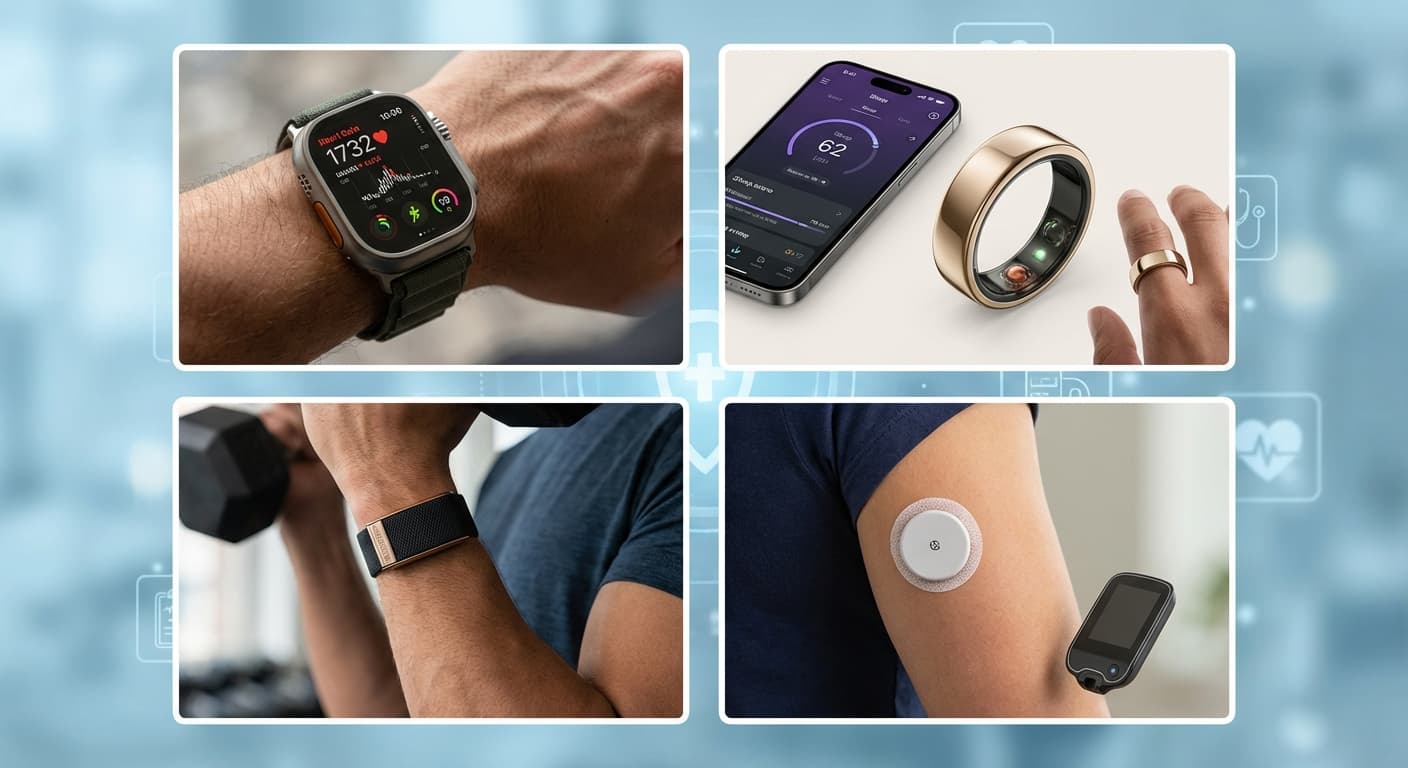
A comprehensive analysis of wearable health technology, comparing smartwatches, fitness trackers, and smart rings to help you choose the perfect health monitoring device for your needs.
1. The Nature of Wearable Health Technology and Its Categorization
Know that the domain of wearable health technology has expanded beyond mere pedometers into a sophisticated ecosystem of biometric surveillance. It is essential for the seeker of knowledge in this field to understand that these devices are not monolithic; rather, they are divided into categories based on their function, placement on the body, and the depth of data they provide. The contemporary landscape suggests that the wearable health device is no longer a niche accessory for the athlete alone but has become a fundamental component of modern existence.
In examining the current market, one finds that the devices fall into three primary classifications. First, there is the health smartwatch, which combines communication utilities with biometric tracking. Second, the dedicated fitness tracker, which prioritizes battery efficiency and movement data over diverse applications. Third, the emerging category of smart rings and specialized biosensors, which seek invisibility and passivity.
The implication of this technology on social life is profound. It transforms the wearer from a passive subject of their own biology into an active analyst of the "Quantified Self." In the style of Silicon Valley analysis, we observe that this shift drives a new social currency: the sharing of rings, the closing of rings, and the optimization of sleep scores. It is not hidden from the one of insight that this constant monitoring creates a psychological state wherein one feels naked without their data.
When evaluating wearable health devices, one must look past the marketing language of "revolution" and "magic" and scrutinize the sensors themselves. Are we dealing with optical heart rate sensors (PPG) alone, or does the device include ECG, EDA (electrodermal activity), and skin temperature sensors? The distinction is vast. The former offers a general approximation of exertion, while the latter approaches the realm of medical insight.
Therefore, the foundation of choosing the best device lies in defining the intent. If the intent is to disconnect from the noise of the digital world while maintaining vigilance over one's physical state, the screen-less tracker is superior. If the intent is total integration and responsiveness to the immediate demands of communication and health simultaneously, the smartwatch is the required path.
- Key Consideration: The presence of a screen determines the social intrusiveness of the device.
- Key Consideration: The sensor stack determines the validity of the health insights.
Explore All Wearable Health Devices
2. The Verdict on Form Factors: The Wrist Watch Versus The Smart Ring
Regarding the dispute between the wrist-worn fitness tracker and the finger-worn smart ring, there are differing schools of thought. The correct view depends upon the user's tolerance for friction in their daily life. The health smartwatch, such as the Apple Watch or the Pixel Watch 3, commands attention. It occupies the prime real estate of the wrist, demanding interaction and serving as a badge of technological compliance.
However, a growing cohort of users prefers the subtlety of the smart ring. It is observed that the ring form factor, exemplified by devices like the Oura Ring 4, offers a "set and forget" methodology. This aligns with the principle of passive monitoring, where the best wearable health gadget is the one that does not require constant tending. For the socialite or the executive who wishes to wear a traditional mechanical timepiece, the smart ring is the permissible solution, allowing one to track health without sacrificing aesthetic tradition.
We must also address the limitations of physics. The wrist allows for a larger battery and greater surface area for sensors to contact the skin. The ring is constrained by its minute circumference. Thus, if one seeks the absolute pinnacle of sensor density—including GPS for route tracking and cellular connectivity for independence from the phone—the smartwatch is undoubtedly superior. The ring cannot yet house the antennas required for independent communication without becoming cumbersome.
Comparison of Form Factors:
| Feature | Smartwatch | Smart Ring |
|---|---|---|
| Visibility | High (Social Signal) | Low (Discrete) |
| Battery Life | 1–3 Days (Typical) | 4–7 Days (Typical) |
| Sensors | HR, ECG, GPS, Temp | HR, SpO2, Temp |
| Interaction | Touchscreen, Voice | Passive, App-only |
It is incumbent upon the buyer to recognize that the ring is primarily a recovery tool, focusing on sleep and readiness, while the watch is an activity tool, focusing on output and exertion. To confuse the two is to err in expectation.
Compare Smart Rings and Watches
3. On the Accuracy of Sensors and Reliance Upon Them
A question often arises: Can we consider health monitoring devices a doctor in digital form? The answer is a decisive no, though they serve as a witness to the body's trends. The wearable devices in healthcare are categorized as "consumer-grade" rather than "medical-grade," with specific exceptions where FDA clearance has been granted for atrial fibrillation detection (ECG).
The discrepancy lies in the method of data collection. Photoplethysmography (PPG)—the green lights flashing against the skin—measures blood volume changes to estimate heart rate. This method is subject to "noise" caused by movement, skin pigmentation, and the tightness of the band. Therefore, to rely upon a wearable heart monitor for absolute diagnostic truth is an error in judgment. It is, however, an excellent tool for observing the delta—the change in baseline over time.
Socially, this reliance on accuracy has created the "worried well"—individuals who obsess over minor fluctuations in Heart Rate Variability (HRV) or blood oxygen levels (SpO2). The scholar of technology must warn against this hyper-fixation. If the device reports a poor sleep score, the user may feel fatigued simply by suggestion, a phenomenon known as the "nocebo effect."
Key Accuracy Metrics to Scrutinize:
- Sleep Staging: Distinguishing between REM, Deep, and Light sleep.
- Step Count: Generally accurate but easily fooled by hand movements.
- Caloric Burn: Highly variable and often overestimated by manufacturers to encourage the user.
Thus, tracking your health data through wearable devices should be viewed as reviewing a trend line, not a laboratory report. The wearable health monitoring devices project is an ongoing pursuit of perfection, but we have not yet reached the station of infallibility.
Check Accuracy of Whoop Devices
4. The Obligation of Battery Life in a Daily Companion
It is established that a device with a dead battery possesses no utility. Therefore, the endurance of the power cell is a critical attribute of the smart wearable device daily companion for health. There is a distinct divergence in philosophy here. The computational heavyweights sacrifice battery life for performance, requiring a charging ritual that must be performed daily. Conversely, specialized trackers prioritize longevity.
The social implication of battery life is often overlooked. The "charging anxiety" tethers the user to the grid. If one travels, one must carry specific proprietary cradles. The truly liberated wearable health tech is that which allows the user to forget the charger for a week or more. This allows for continuous data capture, specifically sleep tracking. A watch that must charge at night cannot track the quality of rest, rendering half of its health purpose void.
Battery Tiers in the Market:
- Tier 1 (Daily Charging): Pixel Watch 3, Apple Watch. (High functionality, low endurance).
- Tier 2 (Weekly Charging): Whoop, Oura Ring. (Balanced utility).
- Tier 3 (Monthly+ Charging): Specialized hybrid watches.
If you are a person who forgets to charge devices, it is not permissible for you to purchase a high-maintenance smartwatch, for it will end up in a drawer, becoming electronic waste rather than a health aid. The best device is the one that is worn; the battery dictates the wearing habits.
5. The Examination of Heart Monitoring Capabilities
The heart is the engine of the body, and the wearable heart monitor has become the central feature of these devices. Modern optical heart rate sensors have advanced to the point where they can track resting heart rate (RHR) with high precision. This metric is a fundamental indicator of cardiovascular fitness and stress.
However, the advanced user seeks more than simple beats per minute. The inclusion of Heart Rate Variability (HRV) tracking is a marker of a sophisticated device. HRV measures the time variation between heartbeats and serves as a proxy for the nervous system's balance. A high HRV indicates recovery; a low HRV indicates stress or illness. Devices like Whoop have built their entire philosophy around this single metric.
Furthermore, we see the democratization of ECG (electrocardiogram) features. By placing a finger on the crown of a watch, one can close a circuit and detect electrical anomalies. This is a profound advancement for wearable devices in healthcare, allowing for the early detection of conditions like Afib. However, one must not become hypochondriacal, checking one's ECG without symptoms.
Checklist for Cardio-Focused Buyers:
- Does it offer high/low heart rate notifications?
- Does it track zones during exercise (Zone 2 training is currently in vogue)?
- Is the sampling rate continuous (every second) or periodic (every few minutes)?
6. The Reality of Data Privacy and The Quantified Self
It is necessary to speak on the matter of wearable health tech and the ownership of the self. When one straps a sensor to their body, they are transmitting the most intimate details of their existence—their location, their stress levels, their menstrual cycles, and their sleeping habits—to corporations.
The user must ask: Who owns this data? Is it the user, or is it the conglomerate using it to train models and sell advertising profiles? The astute observer knows that if the product is free, the user is the product. However, even with premium hardware, data is often siphoned. Newer devices like Friend or Bee attempt to introduce AI into this mix, adding a layer of conversational data to the biometric data.
Wearable health monitoring devices are not just medical tools; they are surveillance nodes. In the social context, this data is occasionally weaponized—insurance companies may one day demand tracker data to adjust premiums, or employers may use it to monitor "wellness" (which is a euphemism for productivity).
FAQs on Privacy:
- Q: Can my data be sold?
- A: In many jurisdictions, anonymized data can be sold or shared. Check the privacy policy for "third-party sharing."
- Q: Is the data stored on the device or the cloud?
- A: Most modern devices sync to the cloud immediately.
- Q: Can a doctor access my data?
- A: Only if you explicitly export a PDF or link your account to a specific health portal.
Explore Privacy-Focused Wearables
7. Evaluating the Ecosystems: Apple, Google, and Independence
The landscape of wearable health monitoring devices is dominated by the "walled gardens." The Apple Watch is largely useless without an iPhone; the Pixel Watch 3 struggles without the Android ecosystem. This lock-in is a strategy to secure capital loyalty rather than to optimize user health.
There exists, however, a third path: the Independent Ecosystem. Companies like Whoop and Oura operate ostensibly platform-agnostic hardware. For the user who switches between Android and iOS, or who wishes to avoid the hegemony of the tech giants, these independent players offer the best wearable health monitoring devices.
We also observe the rise of niche devices for specific ailments, such as Hapbee for sleep and stress modulation, or Beacon Biosignals for EEG monitoring. These represent the fragmentation of the market into specialized tools.
The Ecosystem Breakdown:
- Apple Health: Highly polished, privacy-centric, but exclusive.
- Google Fit / Fitbit: Data-rich, accessible, but currently in a state of chaotic merger.
- Independents (Oura, Whoop): specialized, subscription-heavy, but focused.
8. The Conclusion Regarding the Best Wearable Health Monitoring Devices
After examining the evidence, weighing the form factors, and scrutinizing the sensors, we arrive at the verdict. There is no single "best" device for all of humanity, for the needs of the marathon runner differ from the needs of the bio-hacking executive.
However, if we are to judge based on the balance of accuracy, utility, and social integration:
- For the iPhone User seeking total integration: The Apple Watch remains the best wearable health gadget due to its unmatched sensor accuracy and life-saving fall detection features.
- For the Data Purist and Athlete: Whoop holds the crown. It prioritizes recovery and strain without the distraction of a screen.
- For the Minimalist: The Oura Ring 4. It provides tracking your health data through wearable devices without the intrusion of a screen, preserving the sanctity of social interaction.
The best wearable health monitoring devices are those that you actually wear. Consistency is the greater part of accuracy. Do not be swayed by features you will not use. Choose the device that fits your life, your wardrobe, and your tolerance for notifications.
In the end, the technology is but a tool. It is the discipline of the user to act upon the data that brings about health.